I’ve always been fascinated by India. It’s my mom’s favorite country, and the house we share is full of treasures from her travels there, from peacock fans and silk scarves, to jewelry boxes carved from mango wood. I grew up in the UK, hearing spellbinding tales of painted elephants and mirrored palaces, and India soon occupied a special place in my imagination. Having got to 42 without making it to the promised land, this summer my chances of going there felt slimmer than ever, as after several rounds of IVF, I was pregnant for the first time. Much to my surprise, I was expecting twins as the single embryo that was transferred had split in two.
The prospect of being a solo twin mom was daunting, but my overwhelming feeling was of joy and excitement. It was the happiest I’d ever been. Everything was progressing well with the pregnancy until my 20-week scan, when my world imploded. The sonographer couldn’t find a heartbeat on either of the girls, and I was told that they had both died. I was led to a bereavement room on the maternity ward and informed that I would need to take a pill and come back in 48 hours to give birth to them. In a state of shock and disbelief, it felt like the events were happening to someone else, the experience too awful to claim as my own.
In the days that followed flowers arrived, cards were sent, and grief steamrolled me as I tried to make sense of what had happened. In search of answers, three weeks later I boarded a plane to Delhi, feeling lost and broken but hopeful that India might help to heal me in some way. I was worried that it might be too soon, and that I hadn’t given myself enough time to recover physically and emotionally, but it felt like a risk worth taking. Before I left I had the girls’ names, Lily and Rose, engraved on the back of a Saint Christopher necklace, the patron saint of travelers. Wearing it brought me closer to them—my angels were protecting me.

Writer Lucy Shaw was able to take her first steps towards healing as a traveler in the midst of Delhi’s bustling street scene.
One of the best things about being in India was the fact that no one knew who I was or what had just happened. To everyone I met, rather than a grieving mother, I was a wide-eyed traveler keen to soak up all the experiences the country had to offer. It felt like I was able to take a holiday from myself and my sad situation, if only when in company. With all of its color and chaos, Delhi forces you out of your head and into your body. There’s no time to dwell on the past or ponder the future as a traveler—you can only live in the present, which was a blessing.

Jaipur’s City Palace is home to the “hall of beauty,” an elaborately adorned mirror chamber decorated with gold leaf and jewelry.
While not an early bird, I started my days with yoga. Having arrived feeling weak and vulnerable, after a few sessions I noticed a small shift when doing the warrior pose, which made me feel stronger and more capable of taking on the world. I’d always been interested in spirituality, but losing the girls made me keen to dig deeper into it. I asked anyone I could about their faith. In Delhi and Rajhastan, the majority of the population identify has Hindu, and the certainty with which the people I spoke to believed that they were currently experiencing one of their many lifetimes, and their complete lack of fear about dying, opened my eyes to a new way of being.
My time in Jaipur, Rajasthan’s capital, helped me to see the beauty in the world again. The City Palace, home to Jaipur’s royal family, is a pastel-colored marvel. The “hall of beauty” is exquisitely decorated with gold leaf and intricate tile work, it walls and mirrors embellished with red and green glass that glows in the light like jewels. The magnificent Blue Room upstairs is where the Maharajas used to take shelter from the monsoon rains. At the Sheesh Mahal (Palace of Mirrors) at the Amber Fort, dazzling mosaics made from meticulously cut mirrors and colored glass glimmer like stars—you can’t help but be bewitched by it all.

Amer Fort in Jaipur welcomes close to 5,000 daily worshippers.
In Udaipur, I visited the Jagdish temple on the eve of Diwali, entering just as dozens of barefoot worshippers began chanting in unison, ringing bells, and clashing cymbals. The sound of their voices was so powerful it went right through me. The Hindu priest leading the ceremony doused us all with rose water. The feeling of the fragrant drops hitting my cheeks was purifying. Witnessing that moment of collective worship was special. It helped me to feel connected to something bigger than myself and recognize that there are things that exist beyond our realm of understanding.
The next day I met a holy man who radiated warmth and kindness. He had such a benevolent energy I immediately felt at ease in his presence. Knowing nothing of my story he read my palm. I felt like Elizabeth Gilbert in Eat Pray Love meeting her own Ketut. He was dressed in elegant silk robes the same peach hue as the Hare Krishnas wear, a red thread bracelet tied around his wrist. He examined my palm with a magnifying glass, studying each line for a long time in contemplative silence. I was worried about what he might find. He told me that I was full of self-doubt and had lost my faith in the world, which was true.
He also said my life hadn’t been easy—my heart line was broken—and that it may take several attempts to get to where I want to be. He encouraged me not to give up, and told me to find strength through meditation and prayer. At dinner that night overlooking Lake Pichola, with the City Palace in the distance casting a golden glow on the water, I noticed a small vase of lilies and another of roses had been placed side by side on my table. I smiled through my tears. The girls were saying hello. On my final day in Udaipur I returned to the temple where I’d met the fortune-telling priest. I sat cross-legged in front of him and we prayed together.
He told me to offer a handful of rose petals and a jug of holy water to Shiva, the god of transformation, then ring the temple’s bell three times and make a wish. With candles lit and incense burning, the prayers continued for a long time. After offering up a syrupy sweet to Shiva and eating one myself, my guru looked me in the eyes and said without hesitation that my wish will come true. I broke down and started sobbing uncontrollably, my shoulders shaking. I’d been holding a lot in during the trip and in that moment it all came flooding out. The release I felt from letting go of the sorrow I was carrying was incredibly cathartic.

Lake Pichola in Udaipur is a man-made lake that showcases temples, ghats, and the famous City Palace along its riviera.
It’s an overused phrase, but my time in India was life-changing. It gave me a new perspective on the world and the chance to process and come to terms with what has happened. Though it’s not always easy to, the trip taught me the importance of living in the moment and accepting life as it is, not how you hope it to be. With profound loss comes profound learning and being in India made me appreciate the value of letting life take you where it wants to take you, and leaning into that uncertainty rather than resisting change.
While I’ll always be sad about losing my girls, and I’ll miss them every day of my life, I feel changed for the better. The experience encouraged me to prioritize the things that are worth my time and energy and let go of the things that aren’t. As well as an unforgettable adventure around Rajasthan that surpassed my expectations, India also took me on an inward journey that has helped me to find peace. I returned wanting to run towards life, not away from it. And while the future remains uncertain, I feel hopeful again.
Sacred spaces for holistic healing
The following places offer a safe space to start the healing process, from sanctuaries to guide you towards inner peace, to spiritual sites that will help to restore your faith in the world.

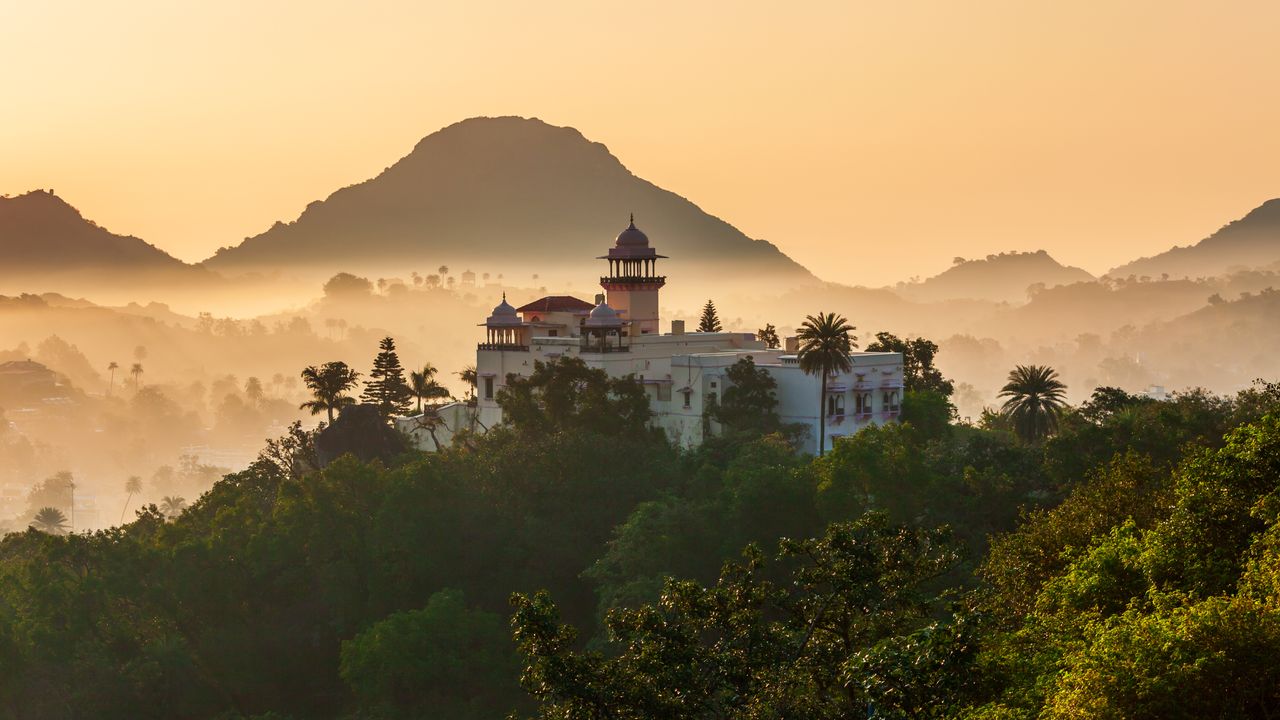
Leela Palace Udaipur is seated amongst the banks of Lake Pichola.
Temple Blessing at the Leela Palace Udaipur, India
In Rajasthan’s ethereal “white city” you’ll find this tranquil palace hotel floating on the banks of Lake Pichola. The setting alone is healing in itself—you can spend hours watching the birds swoop and sun set over the lake—but it also offers traditional blessing ceremonies at the 16th century Shiva temple within its grounds.
Water Purification Ceremony at COMO Shambhala, Bali
Guests staying at this hilltop retreat in the middle of the Balinese jungle can experience a water purification ceremony at the sacred spring within the Tirta Empul temple. Begin by making an offering under an ancient banyan tree then take part in a series of cleansing rituals in the temple’s holy waters designed to rid the body of negative energy.
Meditate with Monks at Bhutan Spirit Sanctuary, Bhutan
Bhutan’s only five-star luxury wellness resort offers an array of healing experiences, from transformation rituals to herbal treatments rooted in traditional Bhutanese medicine. After a hike to the Eutok Goenpa monastery, you can meditate with Buddhist monks then talk to some of the senior monks during a tea ceremony, which can be arranged upon request.

Mayan cleansing rituals are at the heart of wellness at Yaan Healing Sanctuary Mexico.
Claus Brechenmacher & Reiner Baumann
Moon Temazcal Ceremony at Yäan Healing Sanctuary, Mexico
Symbolizing rebirth, this cleansing ritual in Tulum is led by a Mayan mystic during the monthly moon cycles. Designed to help participants heal, you’ll be guided into a dome-shaped hut and taken through the four doors of a pre-Hispanic sweat lodge ceremony, which involves being engulfed in herb-infused steam created by hot volcanic stones.

Dwarika’s Sanctuary Nepal is surrounded by 25 acres of rugged forest and the Himalayan Mountains.
Salt House Breathwork at Dwarika’s Sanctuary, Nepal
Set within 25 acres of natural forest amid the Himalayan peaks, this Nepalese sanctuary is the perfect place to find inner peace. Head to its Himalayan rock salt house for a pranayama breath work session designed to restore balance. Crafted from 20 tons of rock salt crystals, the saline air is beneficial for the respiratory system, helping you to breathe easy.
This article was originally published on Condé Nast Traveller UK.
Originally published at Conde Nast Traveler