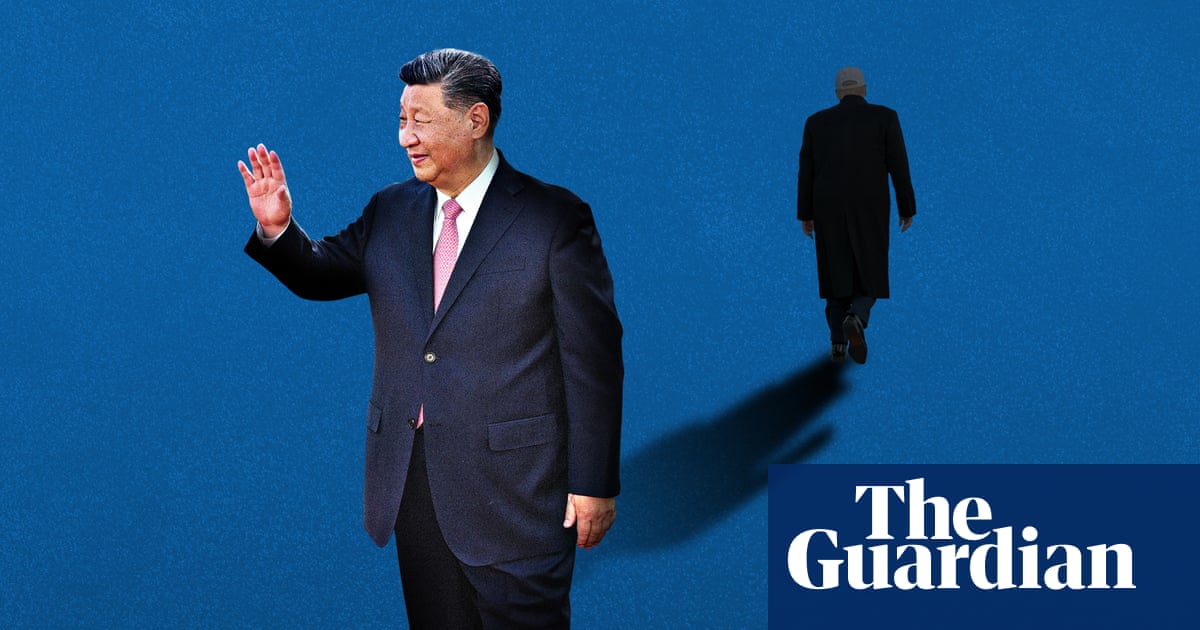
In the search for stability, some western nations are turning to a country that many in Washington see as an existential threat
If geopolitics relies at least in part on bonhomie between global leaders, China made an unexpected play for Ireland’s good graces when the taoiseach visited Beijing this month. Meeting Ireland’s leader, Micheál Martin, in the Great Hall of the People in Beijing, China’s president, Xi Jinping, said a favourite book of his as a teenager was The Gadfly, by the Irish author Ethel Voynich, a novel set in the revolutionary fervour of Italy in the 1840s.
“It was unusual that we ended up discussing The Gadfly and its impact on both of us but there you are,” Martin told reporters in Beijing.
China is on a charm offensive with western leaders, a path cleared by Donald Trump’s increasingly erratic and destabilising power grabs on the global stage. Although Europe breathed a sigh of relief this week when Trump withdrew the threat of using military force in Greenland and said he would not impose tariffs on opponents of his plans in the Arctic, the US no longer seems like a reliable partner.
An editorial in the Chinese newspaper the Global Times made Beijing’s pitch clear: headlined “Europe should seriously consider building a China-EU community with a shared future”, the state media article said the world risked “returning to the law of the jungle” and that China and the EU should cooperate in building “a shared future for mankind”.
No country can afford to cut ties or truly antagonise the world’s biggest economy. But in the search for stability, US allies are turning to the country that many in Washington see as an existential threat: China.
“With US policy again looking unpredictable – underscored by tensions and tariff threats over Greenland – European leaders are making sure to keep channels with Beijing open,” says Eva Seiwert, a senior analyst at the Mercator Institute for China Studies. “The risk is that this approach sustains or even deepens existing dependencies on China at a moment when Europe’s stated goal is de-risking.”
Mark Carney, elected as Canada’s prime minister on promises to stand up to bullying from the US, set the tone for western countries’ recalibration with China when he travelled to Beijing last week. “Canada is forging a new strategic partnership with China,” Carney said. The global order, he said, was at a point of “rupture … not a transition”.
Officially, China views this rebalancing with caution. Another article published in state media this week explicitly hit back at the idea that China welcomed the current chaos.
Song Bo, a fellow at Tsinghua University’s Center for International Security and Strategy, says Chinese policymakers are unwilling to publicly admit that the global order has fundamentally changed.
“We have always believed that we are the greatest beneficiary of the international order established after the cold war,” Song says, referencing China’s rapid economic growth that came with the globalisation of the 1990s and 2000s. “It is difficult for us to accept that the current order is undergoing a major transformation.”
Another perspective on the matter comes from Ryan Haas, a senior fellow at Brookings. In a post on X, he wrote: “In viewing Trump’s efforts to gain control of Greenland, Beijing appears to be following Napoleon’s maxim: ‘Never interrupt your adversary when he’s making a mistake.’”
Because although China pledges allegiance to the international rules-based order, Xi has long talked of the world undergoing “great changes unseen in a century”, echoing Carney’s sentiment of global “rupture”. Seiwert says: “Beijing could use Carney’s language rhetorically to suggest a shared diagnosis of US-centric instability, even if there is no convergence on values, interests or outcomes.”
Carney’s pitch for China comes in part from his hostile relationship with Trump. In Trump’s rambling address to Davos, he lambasted Carney for failing to be “grateful” to the US. “Canada lives because of the United States. Remember that, Mark,” Trump raged.
Rather than kowtow to the southern neighbour, Carney is trying to lessen his country’s dependence on the US. In Beijing, he agreed to lower tariffs on Chinese electric vehicles from 100% to 6.1%, diverting from an alignment with Washington that had left one of China’s key exports in effect blocked from the North American market.
Chinese EVs are now on course to make up about one-fifth of Canada’s EV sales, if not more. The deal is a major political win for China, even if it represents only a small share of China’s EV exports. Concerns about economic dependence on China and even Chinese interference in Canadian elections appear to have dropped down the agenda.
Keir Starmer, the UK prime minister, arrives in China next week with a slightly different set of circumstances. He has a warmer relationship with Trump, although his rhetoric hardened in recent days with spats over Greenland and the Chagos Islands. And he is under pressure at home to show he is tough on China when it comes to security and human rights, two issues that inflamed the issue of the controversial Chinese mega embassy application in London, which the government approved this week in the face of intense opposition.
“Starmer may not have proved himself an effective prime minister or knowledgable about China, but he is not stupid,” says Steve Tsang, the director of the Soas China Institute. “He will want to improve relations with China to improve the UK’s economy and trade, but he is not going to see China as a more reliable partner to the UK than the US.”
Nevertheless, like Carney, Starmer will be hoping to ink deals and drum up much-needed investment in the UK economy. He will be accompanied by representatives from blue-chip British companies and is expected to revive a UK-China CEO council, despite growing concerns about the national security risks of Chinese investments.
The pivot to Beijing is far from straightforward. Song notes that the leadership of the European Commission remains hostile to China, something that Chinese officials and business leaders find hard to square with the supposedly warmer ties between China and individual European countries.
According to Song, the bloc’s overall frostiness and the war in Ukraine are the biggest barriers to deepening ties. “Without resolving these two issues, Sino-European relations will not see any significant improvement,” Song says.
Ukraine may be particularly high on the agenda for Petteri Orpo, Finland’s prime minister, who lands in Beijing on Sunday. “China’s support for Russia has definitely strained relations with the Nordic states and Finland is no exception,” says Patrik Andersson, an analyst at the Swedish Institute of International Affairs. But Andersson notes that Finland’s China relations have typically been more stable than those of Sweden and Norway, and this visit is likely to bolster those ties.
In the months after Russia launched its full-scale invasion of Ukraine in 2022, European countries wrestled with the fact that many were dependent on Russia for key commodities such as fossil fuels. There were calls to avoid falling into a similar situation with China, the world’s most important supplier of clean energy technology. Even back in 2020, the chair of the UK’s joint intelligence committee, Simon Gass, said: “China represents a risk on a pretty wide scale.”
Such concerns may be fading into the rearview mirror as middle powers seek to cling on to a world of multilateralism in the face of a wrecking ball swung by the country that was once its greatest defender. China insists Trump’s behaviour is nothing to celebrate. But the outcome may nevertheless strengthen Beijing’s position on the world stage.
Additional research by Lillian Yang
Originally published at The Guardian