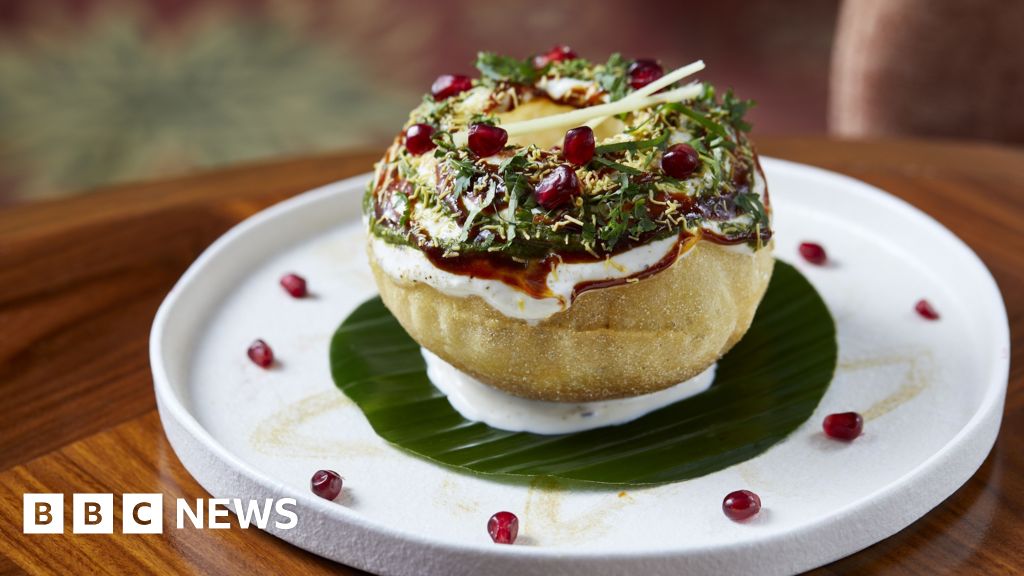
Campaigners trying to prevent the closure of the UK’s oldest surviving Indian restaurant are going to take a petition to Buckingham Palace in the next few weeks, calling on King Charles III to intervene.
Veeraswamy, a restaurant founded in 1926 and still in its original location on London’s Regent Street, faces not having its lease renewed in a dispute with its landlord, the Crown Estate.
King Charles has been an advocate for building links between communities and the restaurant’s supporters are calling for his backing to protect it as “a living piece of shared cultural history”.
But the Crown Estate says the building needs a refurbishment that’s not compatible with the restaurant remaining.
“This is not a decision we’ve taken lightly,” said a Crown Estate spokesman about not renewing the lease and removing the restaurant from its current premises.
The Crown Estate is an independent property company, whose profits go to the Treasury.
Veeraswamy’s battle to stay open, on a site where it kept serving food through the wartime Blitz, has been backed by a petition that’s gathered more than 18,000 signatures.
Celebrity chefs such as Raymond Blanc, Michel Roux and Richard Corrigan have added their voices to calls for a re-think on closing the Michelin-starred restaurant.
“Most European cities cherish their legendary resturants. Why in the name of God would we want to lose Veeraswamy?” said Corrigan.
The petition calls on King Charles to back the campaign to “protect a historic institution” and save a “symbol of Indo-British cultural connections”, as the restaurant approaches its 100th birthday in March.
It will be brought to the gates of Buckingham Palace by supporters and chefs.
And a centenary dinner in March, expected to be attended by celebrities and public figures, will be another moment to rally support.
Lucy Haine, chair of the Soho Society, which has campaigned to protect the distinctive character of the area, is backing “the fight to keep this iconic London restaurant open and trading for future generations”.
Closing it would be a “major loss to London’s history and culinary heritage”, she said, with the society wanting the restaurant to be recognised as an “asset of community value”.
While Indian restaurants are now a staple of UK life, when Veeraswamy opened it was among the ground-breaking pioneers. It initially appealed to Anglo-Indians in London who missed the food they had enjoyed in India.
Co-owner Ranjit Mathrani says generals, civil servants and businesspeople who had links with India first came here, along with expatriate Indians. Mahatma Gandhi and Jawaharlal Nehru, India’s first prime minister, were among its customers.
It became a fashionable West End venue, attracting a social glitterati including actors Charlie Chaplin and Marlon Brando and political figures including Sir Winston Churchill. More recently Princess Anne, David Cameron and Andrew Lloyd Webber have been visitors.
The restaurant has been to Buckingham Palace before – its chefs provided the catering for important Indian visitors in 2008 and 2017.
And it claims to be the birthplace of that most British of combinations: curry and beer.
Prince Axel of Denmark liked to drink Carlsberg while at the restaurant in the 1920s, beginning that culinary love affair.
Mathrani says his restaurant represents an important part of the history of the Indian community in Britain and that Veeraswamy “broke the ice” for the generations of Indian restaurants that followed.
It has played an “important part” in its customers’ lives, he says.
“We have people coming in to say: ‘I first came here with my godfather when I was aged 12’ or ‘I was engaged here during the Blitz’ or ‘I came here because my uncle brought me here in the 1950s’.”
The co-owner is hoping the King might have a “quiet word” in support of the restaurant.
But Buckingham Palace says it’s a matter for the Crown Estate.
The restaurant is a time-slice of the encounter between Indian food and Britain.
A 1947 menu shows customers being offered “Indian fare” – such as Madras chicken curry, tarkari ka salan (vegetable curry) and khur gosh ka salan (rabbit curry). You could wash it down with a bottle of 1934 Veuve Clicquot champagne for £3.
By 1952, the menu had items such as chicken korma, chicken vindaloo, “tika khabab” and poppadums.
Veeraswamy introduced the UK’s first tandoor oven that decade – and a 1959 menu offers chicken tandoori for the equivalent of 52p in pre-decimal currency.
The restaurant received a Michelin star in 2016, on its 90th anniversary.
Veeraswamy’s dispute with the Crown Estate follows the landlord’s plans to modernise the building it occupies, Victory House, a Grade II-listed building on Regent Street, not far from Piccadilly Circus.
Planning documents show it would mean turning the restaurant space into office accommodation and changing the current entrance in a way that would make the restaurant inaccessible.
A Crown Estate spokesman says it understands this is “disappointing” for Veeraswamy and it has offered to help to find other premises in the West End along with financial compensation.
“We need to carry out a comprehensive refurbishment of Victory House to both bring it up to modern standards, and into full use.”
The spokesman adds that so far there have been no alternative proposals which meet “our responsibilities to manage public money”.
Unless a settlement is reached, the dispute is heading for court later this summer, with the restaurant challenging the non-renewal of its lease.
The threat to Veeraswamy follows an unsuccessful effort to protect another distinctive and historic Indian dining institution in London, the India Club, which closed in 2023 to redevelop the building.
Veeraswamy’s co-owner still thinks there could be a compromise to allow the restaurant to stay – and Mathrani says that its location provides a “sense of place and continuity”.
It shows “cultural insensitivity” to try to move the restaurant from this busy corrner of the West End, where it’s been for generations, he says.
“This is where we should be.”
Sign up here to get the latest royal stories and analysis every week with our Royal Watch newsletter. Those outside the UK can sign up here.
Originally published at BBC News