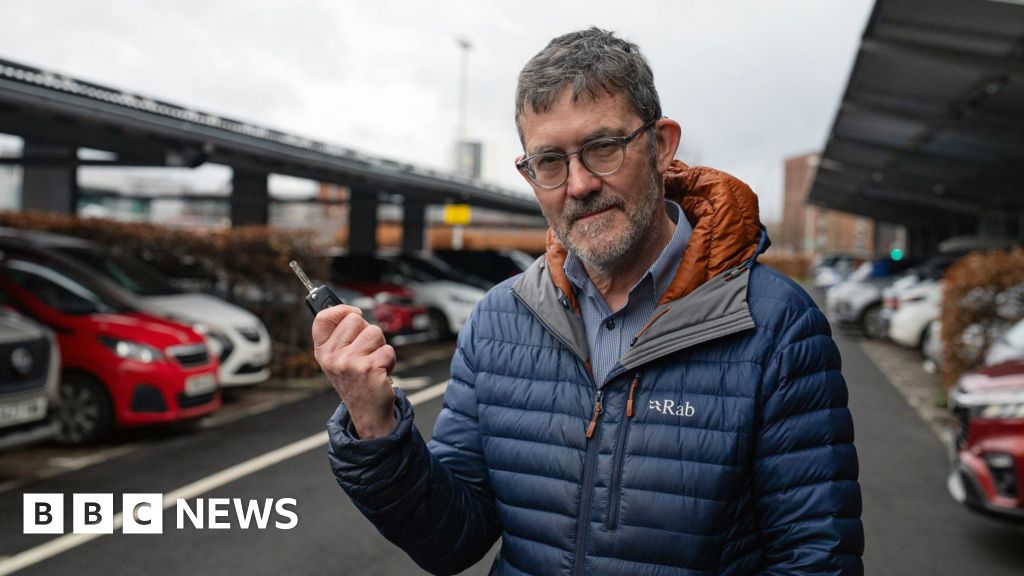
I’m standing by my garden gate, car key in hand and a puzzled look on my face. My car isn’t there.
For a few seconds, I clutch at innocent explanations. Was the road busy last night? Did I park around the corner? But there are no alternative explanations. My car has been stolen.
Two police officers who visit my home quickly discover it was clocked by a number plate recognition camera shortly after midnight somewhere in Glasgow, about 20 miles away. Beyond that, the trail goes cold.
In the days and weeks that follow, I share the experience of about 130,000 UK drivers each year – a police report, insurance claim and the hassle of buying a replacement vehicle.
Along the way, I learned some surprising things about the rapidly evolving nature of car crime.
Since the 1990s, most cars have had coded keys containing an electronic microchip which is paired with an engine immobiliser.
It was meant to make it hard to steal a car without the key – but that didn’t stop these thieves. How did they do it?
The police officers who came to my home told me about something known as a “relay attack”.
It works like this.
One thief stands close to the property, near an area where the car owner is likely to keep their keys – usually the kitchen or the hallway.
They have a piece of equipment which picks up the radio signal emitted by the key fob, then relays it to another bit of kit held by an accomplice next to the car.
If a car has a keyless ignition system, the thieves just push the start button and drive away. Literally gone in 60 seconds.
Another technique is a “CAN bus attack” where a different piece of equipment is plugged into the car’s wiring network, confusing the electronic control system with fake messages and bypassing the immobiliser.
In November, French and Italian investigators arrested five people suspected of manufacturing such devices which have been sold worldwide, disguised as portable Bluetooth loudspeakers.
These gadgets, traded on the Dark Web or using encrypted messaging, can cost thousands. But for a “professional” car crime gang, it’s a long-term business investment.
Sharing the story of my keyless car theft with colleagues, most were surprised but one had heard of this kind of crime, and had some advice: “You should keep your keys in the fridge or microwave.”
It’s simple science – if you surround your key with metal, it blocks the signal so the key can’t be cloned.
For several weeks, the keys for my replacement car shared a space with the yoghurt and leftovers until I invested in a more reliable and hygienic precaution – a Faraday pouch.
It’s a small bag or box, lined with metal mesh or foil, which blocks the electromagnetic signal. You can pick one up for less than a fiver.
My curiosity about car theft secured me an invitation to Police Scotland’s national training centre at Tulliallan in Fife, where Sgt Ally Mackay demonstrated how these signal-blocking containers work – and offered some advice.
“Invest in a Faraday pouch but replace it every couple of years,” he said, “because they become less effective over time.”
My car wasn’t a top-of-the range status symbol. It was a trusty workhorse, a 12-year-old Ford Fiesta with 100,000 miles on the clock. Why go to the trouble of stealing it?
My first thought was: “Kids.” They probably drove around (far too fast) and my car would end up dumped somewhere, a little worse for wear, but hopefully repairable.
A friend of a neighbour who works in the motor trade offered an alternative explanation – it was probably stolen for its engine.
While visiting the Police Scotland training college, I was introduced to Vince Wise, a former Met officer who specialises in car theft, there teaching the latest techniques in identifying stolen vehicles.
He agreed my car was most likely stolen for parts.
“Back in the 80s or 90s it was very easy to get into a vehicle, steal it and take it away. It was probably cheaper than getting a taxi at the time,” he said. “Now, because of the value of vehicles going up and the demand for parts, it’s very easy to move these around and make big profits.”
Low-value cars like mine often end up in “chop shops”, shady workshops where they’re broken up for second-hand components that sell for a fraction of the hefty prices charged for manufacturers’ originals.
A request to Police Scotland for the latest data revealed that Fiestas are actually Scotland’s most common targets for thieves.
Over an 18-month period, 534 were stolen. Another “supermini” – the Vauxhall Corsa – ranked second on 167.
That’s partly a reflection of them being so popular and plentiful. And that also means there’s a big market for second hand spares.
The high cost of manufacturers’ parts has inadvertently provided an incentive for car theft.
It’s also encouraged insurers to write off more damaged vehicles because it costs so much to fix them – which provides another opportunity for criminals.
Those write-offs can end up getting bought in salvage sales, repaired with parts stolen from other vehicles, and then sold on again. That’s less risky than trying to re-sell an intact stolen car.
Vince Wise says there are people who specialise in selling vehicles in the sub-£5,000 bracket where buyers might be less suspicious about the car’s pedigree.
While stolen old bangers like mine don’t travel far, high-value vehicles, if not stripped for parts, are often shipped abroad.
The development of the shipping container industry has simplified the logistics of exporting an entire vehicle.
In his former career as a police officer, Vince often intercepted stolen vehicles at large UK container ports. What surprises me is some of the destinations.
“We came across a lot of vehicles that were going to countries like Tanzania, Kenya, all the way down to South Africa,” he told me.
The explanation? Cars in the UK are configured as right-hand drive because we drive on the left – and that’s the same in many former British colonies in Africa, making them a convenient marketplace.
Other investigations have identified eastern Europe, Russia and the Middle East as popular export destinations where gangs are not too fussy about whether the car is right-hand drive or not.
I ask my car crime experts for their tips on fighting car crime. Fitting a tracker greatly improves the chances of recovering a stolen vehicle, they tell me.
UK police forces only recommend devices with “secured by design” accreditation although there are reports of cheaply available “airtag” type trackers hidden inside a vehicle also yielding vital information on where it’s been taken.
But to my surprise, it’s more basic, low-tech solutions that they focus on. Sgt Ally McKay picks out careful parking as his number-one tip.
“Is it on a driveway where you can see it? Is it well lit? Can you choose somewhere where it’s covered by CCTV? Is there good natural surveillance from you and your neighbours? Anything like that is a deterrent.”
Next up, he lists knowing how your key works and, if appropriate, using a Faraday pouch to protect it. Some smart fobs now let you disable the signal at night.
Manually checking your car is locked is another – thieves can use signal blockers or other tricks to fool you into thinking your vehicle is secure when it isn’t.
And then there’s old-style physical devices – steering wheel locks or even wheel clamps. They aren’t infallible but they will increase the hassle factor for criminals.
“If criminals are able to see you’ve gone to the effort of adding additional security, it makes them think twice.”
Last year, the security think tank Royal United Services Institute (Rusi) carried out an extensive review of trends in UK car crime
It found it had become professionalised, sophisticated, globalised and increasingly linked to organised crime, resulting in an “expensive arms race between criminals and manufacturers”.
In England and Wales, vehicle thefts have risen by around 75% in a decade to more than 120,000 a year, reversing declines seen when new security technology became widespread in the 1990s.
There’s better news from Northern Ireland which has seen a steady fall in thefts, while in Scotland the annual figure is fairly stable at around 5,000.
Rusi’s researcher was told that could simply be a time lag because “novel theft methods” sometimes take up to 10 years to spread throughout the UK.
Several months have now passed since my car was stolen and there’s no further update after that last fleeting camera sighting in Glasgow.
My insurers paid out, a replacement car was bought, but police are keen to stress this is not a victimless crime. Aside from the inconvenience, the costs are ultimately reflected in higher insurance premiums – and that affects all drivers.
Originally published at BBC News